


257 Years is a nine-part series on the history of wine in Southern California, from the Mission grape’s arrival in San Diego in 1769 to the region’s revival today. This is Part Five. Earlier posts are linked at the bottom.
If your email truncates, the full post is on the website and in the app.


Most of us learned about Prohibition the same way. On TV. Someone bootlegged in a story we were watching, and the adults in the room explained. It had something to do with a law that outlawed alcohol, once, a long time ago. Our parents said it didn’t work. It didn’t last. Then the story moved on.
Prohibition lasted thirteen years. From January 17, 1920, to December 5, 1933. And what it did to California wine wasn’t what most people think.
The industry didn’t shut down. It got louder. During Prohibition, Americans made an estimated 111 million gallons of wine at home every year between 1922 and 1929. In 1919, the last year before the ban, commercial wine production in the entire United States was 55 million gallons. So under Prohibition, Americans made twice as much wine as had been made commercially the year before it started. The industry didn’t disappear. It went underground and doubled.
But for Southern California, the story was different. And it didn’t end when Prohibition did.
The Engineered Loophole
The 200-gallon home winemaking exemption wasn’t an oversight. Paul Garrett, the wealthy North Carolina winemaker behind Virginia Dare, helped write it into the Volstead Act. The language was deliberately vague. Each household could produce up to 200 gallons of non-intoxicating fruit juice per year. A term Congress never defined. Everyone understood what it meant.
The Act carried two other loopholes: sacramental wine, which churches could purchase for religious use, and medicinal wine, which pharmacies could dispense by prescription. Together, these three provisions kept the American wine trade alive through the driest years in the country’s history.
Wineries scrambled to fit through one of the three doors. Those that couldn’t, closed.
The Grape Shipping Economy
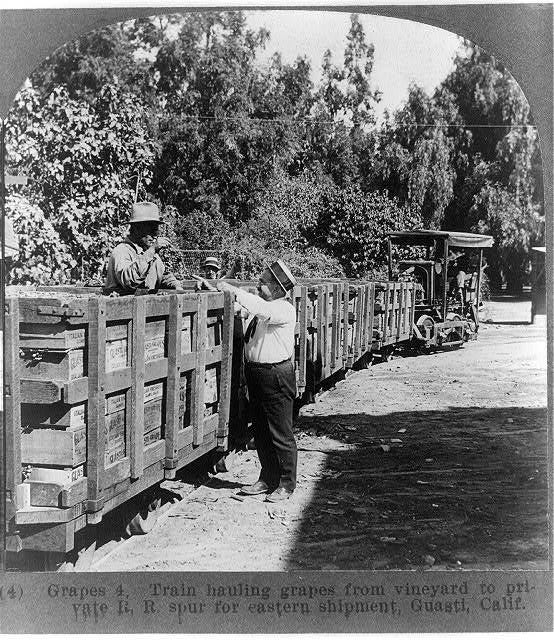
The visible expansion was staggering. In 1920, California had 300,000 acres of grape vines. By 1927, seven years into Prohibition, that number had grown to 577,000 acres. The crop grew from 1.25 million tons to 2.5 million tons. And the shipping doubled and doubled again: 26,000 railcars of fresh grapes rolled out of California in 1920. By 1927, it was 72,000.
Most of those grapes were headed east. To Chicago, Pittsburgh, Philadelphia, New York. The railroads set up grape distribution sites in each city. Italian, Greek, Portuguese, and other immigrant families bought them every fall, hauled them home, and made wine in their basements and garages. It was legal under the 200-gallon rule. And it was much of what Americans drank for thirteen years.
The grapes that traveled well weren’t the noble ones. Cabernet, Riesling, and Pinot Noir were pulled out and replaced with thick-skinned reds that could survive a transcontinental journey: Alicante Bouschet, Zinfandel, Carignan. Deep color, high sugar, sturdy fruit. Not fine wine grapes. Wine-brick grapes.
Meanwhile, Paul Garrett was selling grape concentrate directly to home winemakers under the Vine-Glo label. The concentrate was delivered by your neighborhood druggist in five- and ten-gallon kegs. It came with instructions warning purchasers how not to ferment it, a warning everyone read in reverse.
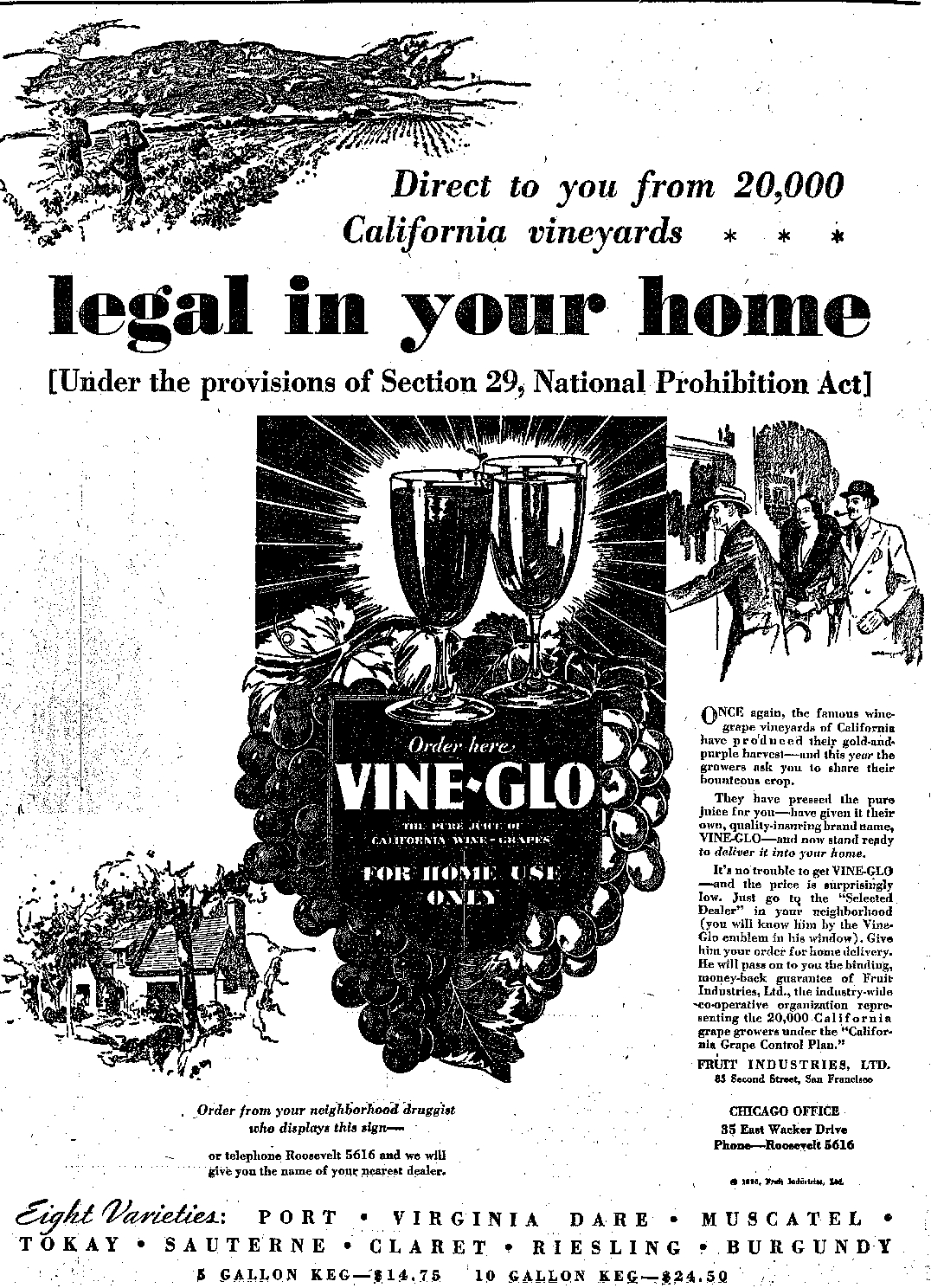
According to Thomas Pinney's history of California wine, a wit at the time said: “America might have become a wine-drinking country, if only Prohibition had lasted long enough.” It didn’t. Overproduction eventually inflated prices, and the Depression shrunk the market. But for seven years, the boom was real.
Pinney also notes something more specific. The planting boom was “faintly heard in Los Angeles County.” Most of the action was in California’s Central Valley, where Gallo and Franzia, and the future bulk-wine giants, were taking root. Southern California was already fading.
The Sacramental Boom
The second loophole made careers.
Georges de Latour, the French-born founder of Beaulieu Vineyard in Napa, had a relationship with the Archbishop of San Francisco going back to 1906. His wife Fernande had made the introduction. When Prohibition took effect in 1920, Beaulieu was better positioned than almost any winery in the state. The winery declared itself The House of Altar Wines and applied for sacramental permits.
Over the next thirteen years, Beaulieu quadrupled in size. De Latour bought up neighboring vineyards being sold for pennies on the dollar. He shipped sacramental wine in barrels marked FLOUR to prevent theft in transit. When repeal came, Beaulieu was one of the largest wine producers in California.
Beringer received permits. So did Wente in the Livermore Valley. Concannon received official permits and made sherry; a surviving 1929 bottle bears the markings “Bonded Winery 616, Permit Calif.” A 854. The Christian Brothers, who ran Mont La Salle in Martinez, produced sacramental wine during the dry years and relocated to Napa in 1932 in preparation for repeal.
In Los Angeles, the Riboli family’s San Antonio Winery, founded in 1917, just three years before Prohibition, survived the same way. Before 1919, they had made about 5,000 cases of wine a year. By 1933, they were making 20,000. Today, San Antonio remains the largest supplier of sacramental wine in the United States. They are also, as noted in Part Three, the only Los Angeles winery to have made it through Prohibition continuously.
There was a math problem underneath all this. Sacramental wine production in California increased 700 percent during Prohibition. But Catholic Mass practice hadn’t changed. Communion under both species, wine and bread, wasn’t opened to congregations until Vatican II in the 1960s. The wine was consumed only by the clergy. So who was drinking the other 700 percent? The answer is that some clergy became de facto distributors. Some parishes ordered more sacramental wine than they could possibly consume. Some sold what they didn’t need. The archdiocese looked the other way. The California wine industry survived on a religious loophole that everyone quietly knew was being stretched.
The Southern California Collapse
The grape shipping economy that made Central Valley growers rich barely touched the south. The Vai brothers in Cucamonga chose the third loophole. They created Padres Wine Elixir, a medicinal tonic sold by prescription in pharmacies. The story of that operation is told in Part Four. The Vai brothers survived. Most of their neighbors did not.
Pinney provides the numbers. In 1922, two years into Prohibition, California had 694 bonded wineries holding legal permits to make wine. By 1927, only 28 of those were in Southern California. By 1929, 25. By 1930, 19. By 1933, statewide, only 177 wineries still held permits, and only a fraction of those were in the south.
The Southern California decline was already well underway before Prohibition even ended.
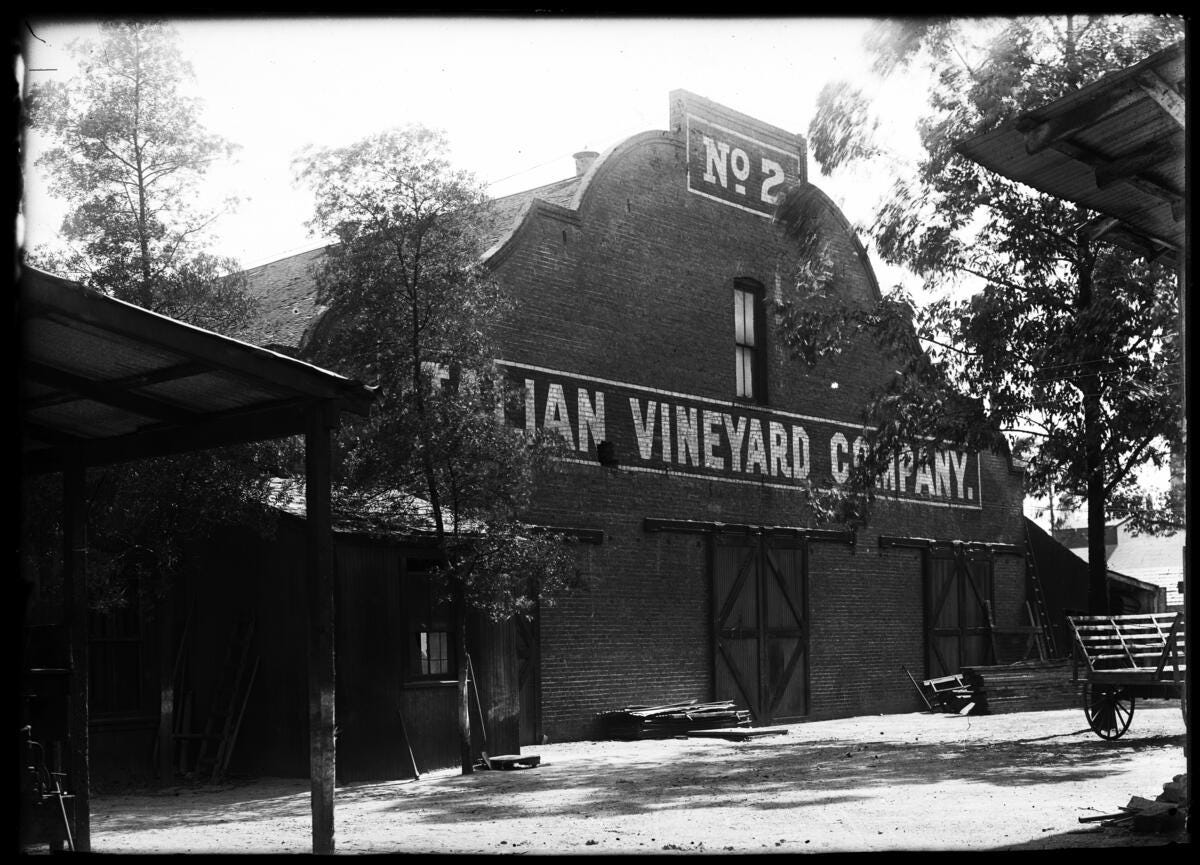
Three large Southern California operations survived intact. The Italian Vineyard Company in Guasti, the largest single vineyard in the world at its 1917 peak, pivoted to grape syrup during Prohibition, producing 454,150 gallons of dry and 1,497,585 gallons of sweet product. The ratio of red to white was seven to one. Secondo Guasti himself died in 1927, six years before repeal, but he had positioned the IVC for the eastern Italian immigrant market whenever the day came. His planning outlived him.
The other two large survivors were the California Mission Vintage Company and the Pacific Wine Company. Pacific dated back to 1889, closed during Prohibition, reopened after repeal as Piuma Winery, and later changed its name back to Pacific Wine Company. It went out of business in 1952.
Smaller operations scrambled. Giuseppe Guerrieri, one of Guasti’s winemakers at the Italian Vineyard Company, left to start his own Santa Fe Winery. The Demateis brothers began ramping up production of Claret, Riesling, Port, Sherry, Muscat, and Angelica in 1932, after Franklin Roosevelt put a repeal plank into the Democratic Party platform. All manner of small Italian winemakers, Pinney writes, tried their hand at “orange wine, vinegar wine”. Surviving without quality.
And a certain kind of desperation showed in the labeling. California wine that did make it to market often went under borrowed names. Bottles were labeled Haut Sauterne, Chianti, Moselle, St. Julien, Pontet Canet, Chateau Yquem. The wine inside was Californian. The names on the bottles pretended to be somewhere else. The industry had lost its identity along with its market.
The Long Erasure — 1933 to 1952
Repeal came on December 5, 1933. That day, 177 California wineries held permits. By year’s end, in the rush of applications, the number had climbed to 380. Total wine production that year reached 20 million gallons.
But repeal was not recovery. And for Southern California, it was not even the beginning of one.
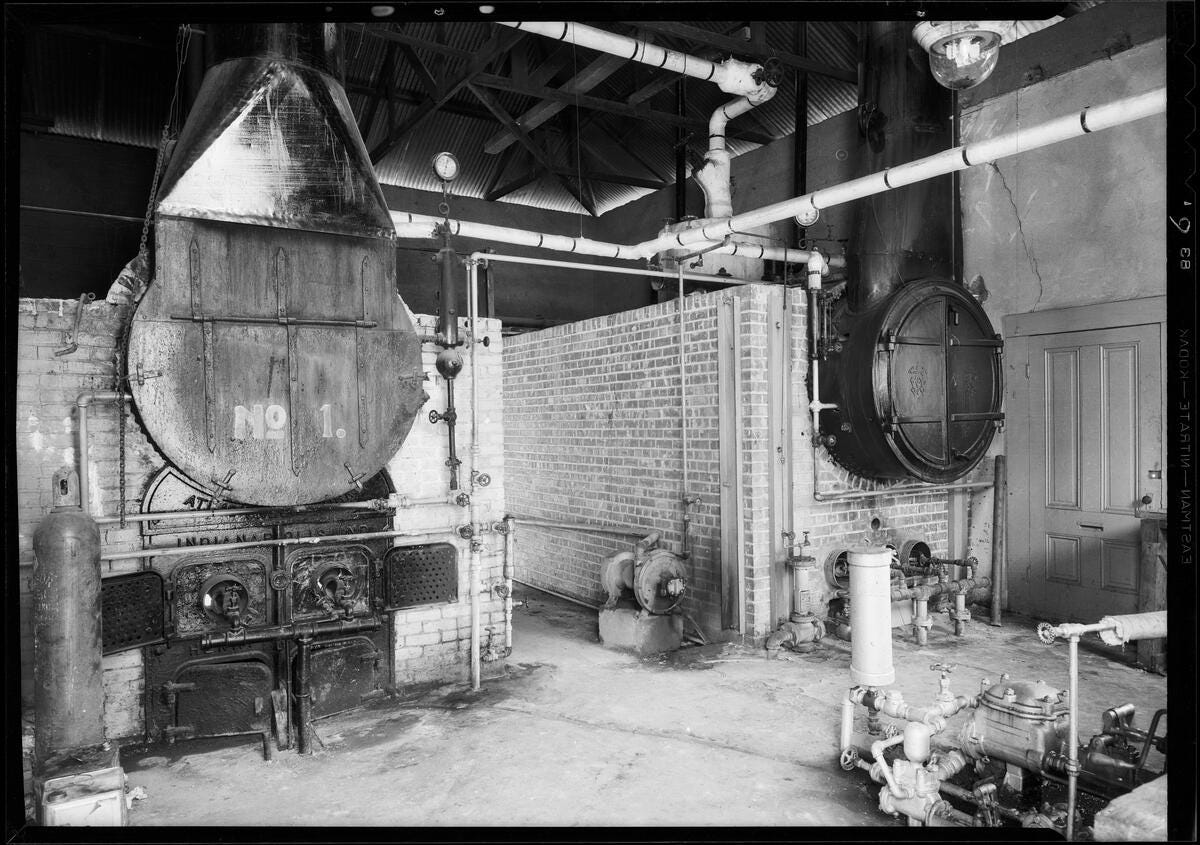
The consolidations began. Antonio Moramarco bought Santa Fe Vintage Company and joined his father in running it. Then he bought Morello Winery in Kerman near Fresno. Then Santa Fe was itself swallowed by the Di Giorgio Wine Company in Kern County and converted into a bonded wine cellar — a bulk storage facility, no longer a producer in its own right. Burbank Winery, opened in 1896 by an Irishman named John McClure and later renamed Sunnyside Winery, then renamed Burbank Winery again, was sold and resold. Buyers came in from the East, from New York, from the Midwest. Often just for inventory. The wineries themselves were sold off in pieces.
Then came the population.
Before the war, California had been underpopulated. In 1940, the state had 6,907,000 people spread across 158,693 square miles. By 1950, that number was 10,586,223. By 1960, it was 15,717,000. More than half of that growth happened in Southern California.
Eight million new residents in twenty years. Every one of them needed a house. Every house sat on land. Much of that land had once been vineyards.
Thomas Pinney’s verdict is direct. “A crucial difference between the southern and northern sections of the trade was that the north had a few big wineries such as the Italian Swiss Colony, making decent table wine, plus a few smaller wineries devoted to making table wines of high quality—among them Inglenook, Beaulieu, Larkmead, and Louis Martini—but the south did not, and could not have, given the irresistible transformation of Los Angeles, city and county.”
Did not, and could not have. The historian’s judgment is not that Southern California failed. It is that Southern California, under those population and real estate pressures, was never going to survive as a wine region on the old terms. What the freeway era finished in Cucamonga (Part Four) had long been set in motion by Prohibition, the Depression, the war, and the postwar boom.
By 1952, the original Southern California wine industry was effectively gone.
What the Silence Meant
What was lost wasn’t only measured in acres and businesses. It was measured in knowledge, taste, and reputation. And those took much longer to rebuild.
Chardonnay in California in 1940, seven years after repeal, covered an estimated 50 to 100 acres. Total, in the entire state. Thompson Seedless, a table and raisin grape, covered 200,000 acres. Alicante Bouschet, the workhorse shipping variety of the Prohibition years, was planted everywhere. The noble varieties that had once made California wine interesting had largely been ripped out.
The tradition of winemaking, Pinney writes, was broken. No research in viticulture or enology had continued through the dry years. Buildings sat derelict. Barrels had dried out and split. The men who had known how to make wine had aged out or moved on. When the industry resumed, it was led by people who mostly did not know what they were doing.
Worse, the American public didn’t know what they had lost. Pinney puts it this way: “few of the American public knew anything about wine apart from a few debased ideas acquired during Prohibition.” Fortified wines and jug wines dominated. Sweet, high-alcohol, cheap. That was what America thought wine was. And that was what California made, in enormous volume, for the next four decades.
There was also a suspicion attached to the trade. For thirteen years, winemakers had been legally indistinguishable from bootleggers. That association didn’t lift with repeal. Pinney notes that in the public mind, in bureaucratic offices, and in legislative chambers, winemakers were still viewed as figures of dubious respectability. It took a generation for that suspicion to fade.
Andre Tchelistcheff arrived at Beaulieu in 1938, sent from France to help modernize the winery. He introduced cold fermentation and malolactic fermentation to Napa. His work over the following decades trained the winemakers who would eventually rebuild California’s reputation. In 1966, Robert Mondavi founded his own winery in Oakville, the first new large-scale Napa winery since before Prohibition. On May 24, 1976, at a blind tasting in Paris, a 1973 Chateau Montelena Chardonnay and a 1973 Stag’s Leap Cabernet Sauvignon beat their French competitors. It was called the Judgment of Paris. It changed everything.
Forty-three years from repeal to that moment. That was Northern California’s recovery. Southern California’s took longer, and looked different. But the record of what had been was still visible, if you knew where to look.
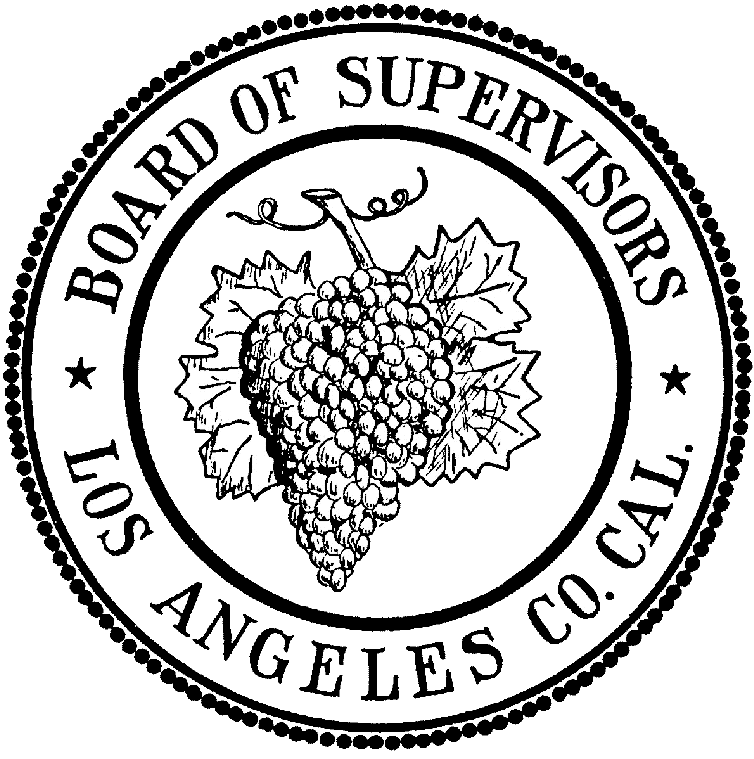
What the Seal Remembers
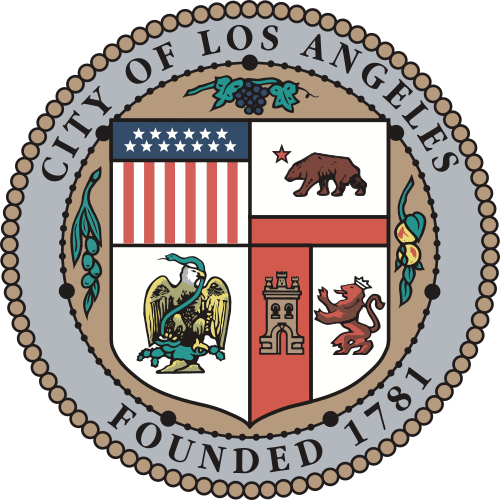
The Los Angeles city seal still shows grapes.
Along its border, among the other emblems of the city’s identity, oranges and grapes sit as small ornaments. Pinney puts it plainly:
“As the original seal of the city made plain, Los Angeles was a place to grow grapes and make wine.”
That’s what the city was, once. It was on the record. It was on the seal. And it was true for over a century, from the pueblo’s founding in 1781 through the collapse of the industry in the middle of the twentieth century. Los Angeles was a wine city.
The vineyards are gone. Cucamonga’s empire is gone. The Italian Vineyard Company, the Padre Vineyard Company, the Pacific Wine Company, the California Mission Vintage Company — all gone. What remained after 1952 was a handful of survivors and a memory.
When Southern California wine began again in the 1970s and 1980s, it did so somewhere else. In Temecula. In Coachella. In Baja. In the Santa Monica Mountains. On land the old industry had never touched. It began as something new, on land that had no history to recover.
That is the story of the posts still to come.
The grapes remain on the seal. The city remembers what it was, even when the ground has forgotten.

If you grew up in California in the second half of the twentieth century, you probably drove past an old winery building without knowing it. A Kleen Blast warehouse. A distribution center. A strip mall. A subdivision named after a vineyard nobody remembers. If you know of one, I’d like to hear about it. What stayed, even after everything else went.
— Jennifer

257 Years is a series on the history of wine in Southern California.
Part One introduced the family thread that started it all. Part Two traced the Mission grape from Spain to San Diego in 1769. Part Three traced Los Angeles as the original wine capital. Part Four traced the freeway era in Cucamonga. This is Part Five.
Part Six, Temecula is Fighting, is coming next Wednesday: the wine region that started from nothing in the 1960s and became the center of contemporary Southern California wine.
From the series:
Part One → 257 Years: How Southern California Lost and Found Its Wine
Part Two → Before Napa, There Was a Boat Leaving Spain
Part Three → Before Napa, Los Angeles Was the Wine Capital
Part Four → What the Freeway Buried: The Pride of Cucamonga

I’m Jennifer Ann Blair. I write about food, wine, memory, and place, following stories that deserve a closer look. I hold WSET Level 3 with Merit and write from the California desert, usually with Archie, my German Shepherd, somewhere nearby.
If this made you curious, surprised you, or brought something back, tap the heart, leave a note, or send it to someone who might want to pull up a chair too.
Hi Jennifer! I'm so glad to have stumbled upon this series. It is fascinating! I grew up in the SGV and moved to Napa a few years ago for a career in the wine industry. I recently returned to LA and can't believe how much wine history there is here. Can't wait to read more.