

Grandma Mary Jane’s Chocolate Cake with Kahlua Frosting
A fluffy, heritage-inspired chocolate cake with a rich, boozy twist featuring homemade Kahlua frosting and an espresso martini pairing made from scratch.

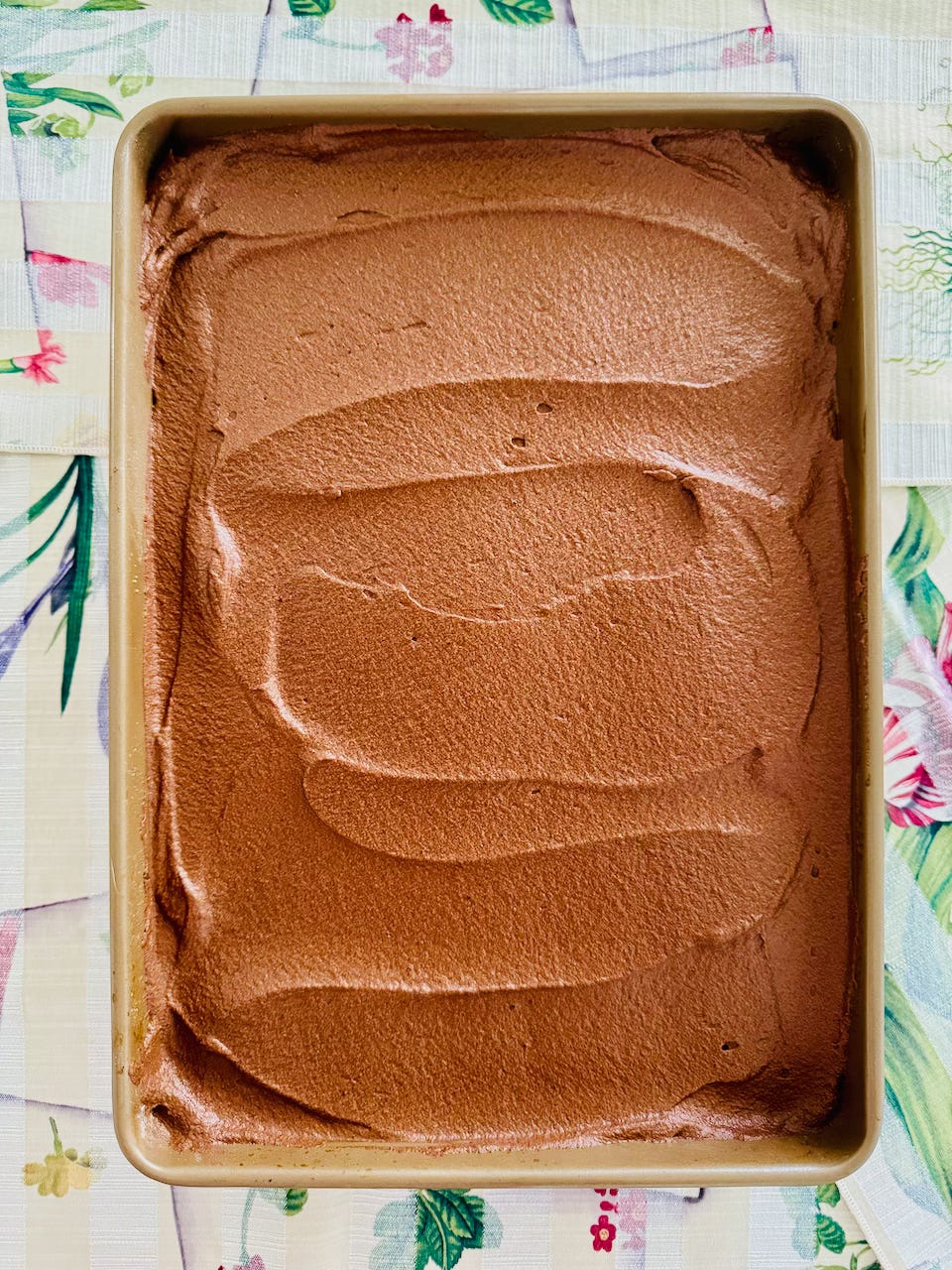
Welcome back.
Pull up a chair while I recreate family recipes and, if necessary, reimagine them for today’s kitchens—paired with stories that linger like the scent of something just out of the oven.
This week, I’m baking my Grandmother Mary Jane’s Chocolate Cake, famous in our family for its rich flavor and chocolatey satisfaction, but also for the memories it creates. As for me? I don’t ever remember tasting it. My mom insists she made it for my sisters and me when we were much younger, but somehow, that memory never stuck. So, in many ways, this feels like a first. A chance to make it, taste it, and maybe reimagine it just a bit.
While recipe testing (2 rounds so far), I realized that the work isn’t just about tweaking, it’s also about clarifying. Recipes from 50+ years ago carry their own cultural context, ingredient expectations, and brand assumptions. We’ll get into those details in a bit.
In the middle of all this mixing and measuring, opening and closing the pantry a dozen times, I spotted the DIY Kahlua we made in February and remembered we hadn’t tried it yet. So, this felt like the perfect time to taste and share. Given the cake's chocolatey goodness, a classic espresso martini seemed just right. Cheers, this one’s going to be fun.
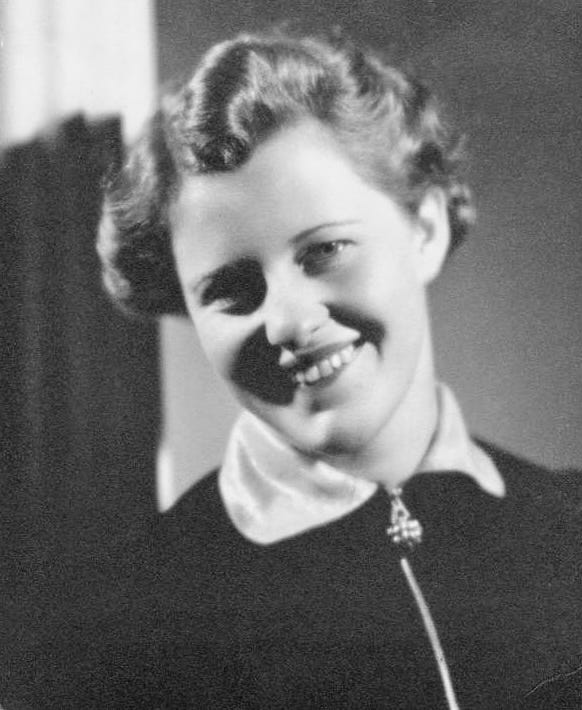
You’ve met my grandmother, Mary Jane Carnes Baker, before. She was a kind, calm woman, always beautifully dressed, and always wore a smile—even when her fiery husband, my Grandfather John Baker, was up to toddler-level mischief well into his elder years. Of course, we grandkids adored him—for exactly that reason. Maybe that’s why she married him.
I found this recipe in a 2006 Reunion Book I compiled for our extended family, filled with stories, photos, and recipes submitted by cousins and siblings who knew Mary Jane and John well. While Mary Jane regularly baked both her own recipes and those passed down from her mother (Helen Carnes) and her mother-in-law (Clara Baker), I can’t find an original handwritten recipe card for this one. Just a shared memory—and now, a chance to bring it back.

Let’s talk ingredients—because that’s where things went sideways the first (and second) time.
Now, I’m not a chef, though I play one on TV (just kidding), but I’ve cooked for over 50 years and watched plenty of Food Network & Magnolia Kitchen. Still, baking is a different beast. And while I did use cake flour the first time, I didn’t use bleached cake flour, which is almost certainly what my grandma used.
Turns out, that one detail makes a big difference.
Cake Flour 101
Cake flour has a lower protein content than all-purpose flour, which means less gluten and a softer, finer crumb. This is essential for achieving the tender texture you want in a chocolate cake. The tradition of using cake flour dates back to the early 20th century, when light, airy cakes were the ultimate proof of a skilled home baker.
Industrialization made flour widely available about 150 years ago, and cake flour hit the market about 130 years ago. After earning a prize at the 1904 World's Fair in St. Louis, Swan Down Cake Flour became a pantry staple in households across the Midwest and beyond.
Yes, the term “bleached” can sound alarming, but it’s safe and has a chemical rationale. Bleaching weakens the flour’s gluten and improves starch absorption, resulting in a better cake. As baking expert Stella Parks writes:
“I can't come up with a single reason to abandon chlorinated cake flour that could ever outweigh its proven benefits.”
That’s good enough for me.
Amazon, please send me a box of Swan Down Cake Flour!
The Cocoa Conundrum
Now onto cocoa, the next unexpected challenge.
The recipe simply listed “cocoa,” with no hint as to whether it meant natural cocoa, Dutch-process (invented 200 years ago). I didn’t know that Dutch-process cocoa, while smooth and rich in flavor, is treated with an alkaline solution that neutralizes its acidity, which means it won’t activate baking soda.
Natural cocoa, on the other hand, is naturally acidic and essential for triggering the chemical reaction that helps this cake rise.
If only recipes back then had listed pH levels instead of just “cocoa”!
But hey, now we know.
Natural cocoa (pH 5-6) reacts with baking soda
Dutch-process cocoa (pH ~7) does not
It’s old-school baking chemistry at its best.
Frosting Freestyle
Now for the part that’s definitely not in the family archives.
The frosting?
I made it up.
Every so often, I get inspired and start creating dishes from scratch. They don’t always work out. This one? A last-minute cliff jump. But I went for it—and it turned out spectacularly.
The base is a classic ganache, traditionally made with equal parts cream and chocolate. But I took a few liberties: I reduced the chocolate by half, added ½ cup of Dutch-process cocoa for extra richness, and whisked in ½ cup of homemade Kahlua—because if we’re pairing this cake with an espresso martini, why not echo that in the frosting too?
And guess what?
It worked.
Spectacularly.
Let’s Taste the Cake!
After diving into ingredient history, baking chemistry, and family lore, I’m ready to stuff my face with frosted cake and wash it down with an espresso martini.


Mary Jane’s Chocolate Cake
Back in the spotlight: a simple, nostalgic chocolate cake from the family archive that is rich, tender, and full of old-school charm.
Prep Time: 10 minutes
Cook Time: 35-40 minutes
Serves: 8-10
Equipment
9x13-inch (23x23 cm) metal pan or two 9-inch round cake pans
Kitchen scale (for gram measurements)
Mixing bowls and spoons
Ingredients
180g (1 1/2 cups) cake flour
400g (2 cups) caster sugar
45g (6 tbsp) natural cocoa powder
1 tsp baking soda
1/8 tsp kosher salt
250ml (1 cup) water
170g (3/4 cup) unsalted butter, melted
2 large eggs
Instructions
Preheat the oven to 350ºF (175ºC).
Grease your cake pan(s) with butter and lightly dust with flour.
In a large bowl, sift together the flour, sugar, cocoa, soda, and salt.
Add the water and melted butter. Mix until just combined.
Stir in the eggs last. Do not overmix.
Pour the batter into a 9x13 inch (23x33 cm) metal pan or two 8-inch round cake pans.
Bake for 35–40 minutes, or until the cake bounces back when gently pressed or a knife is inserted into the center.
Cool completely before slicing or frosting.
Chocolate Kahlua Frosting
A freestyle frosting that turned out so well, it might just become a tradition.
Time: 15 minutes
Equipment
Ingredients
454g (2 cups) heavy cream
85g (1 cup) chopped chocolate or chocolate chips
43g (1/2 cup) cocoa powder
43g (1/2 cup) DIY Kahlua
Instructions
In a small saucepan, bring the heavy cream to a gentle boil.
In a large bowl, combine the chopped chocolate, cocoa powder, and Kahlua.
Once the cream is scalded, pour it over the chocolate mixture.
Whisk slowly until smooth, pressing out any lumps of cocoa powder as needed.
Set aside to cool to room temperature.
When ready to frost, add the mixture to a stand mixer fitted with a whisk attachment and beat on high until creamy and fluffy.
Frost your cooled cake as desired.
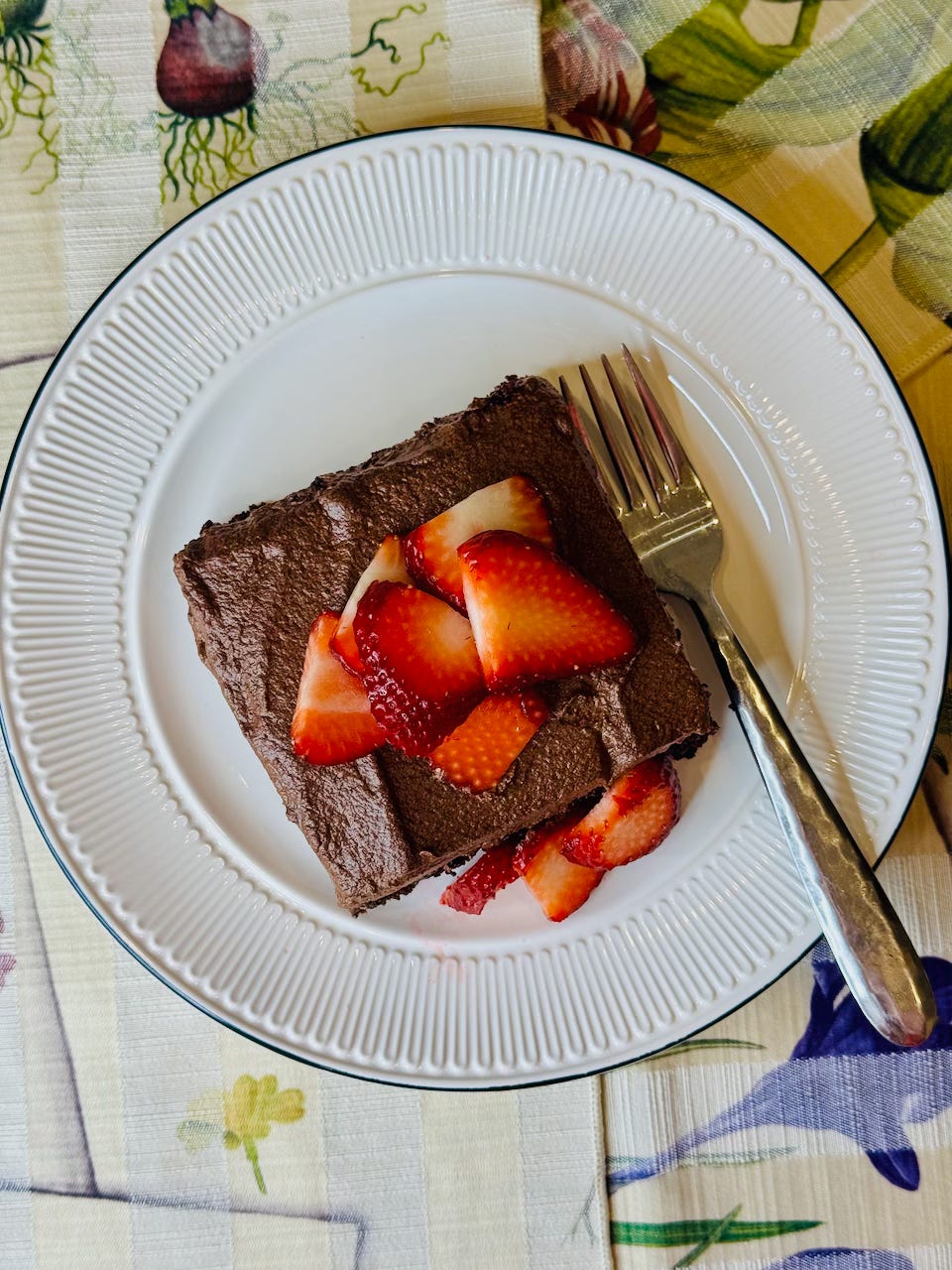
Serve perfectly plain or topped with fresh berries. Even better, the next morning—chilled from the fridge and paired with a hot espresso.

Notes
Cake flour matters: It gives a lighter texture—don’t swap for all-purpose flour.
Natural cocoa only: Dutch-process cocoa is less acidic and won’t react properly with the baking soda.
For moist layer cakes: Make a simple syrup using equal parts sugar and water. Once cooled, flavor with Kahlua, espresso, or vanilla, and lightly soak (not sweep) the cake layers with a pastry brush.
Chill before slicing: For clean layers, chill the cake before slicing to reduce crumbs.
Frosting tip: Never frost a warm cake! It will melt or tear. Chill or freeze layers for 30–45 minutes to make frosting easier and cleaner.
Substitutions
Gluten-Free? Use a 1:1 gluten-free baking flour with xanthan gum (I recommend King Arthur’s) and confirm your cocoa is certified GF.
Dairy-Free? Substitute butter with melted coconut oil or a plant-based alternative, such as Miyoko’s.
Vegan? Use dairy-free butter and replace each egg with a flax egg (1 tbsp ground flax + 3 tbsp water per egg). You may need to slightly adjust the bake time.
Make Ahead + Storage Tips
The frosting can be made up to 3 days ahead and stored in an airtight container in the refrigerator.
Bring to cool room temperature before whipping and using.
Any leftover cake should be stored covered at room temperature for up to 2 days or refrigerated for up to a week.

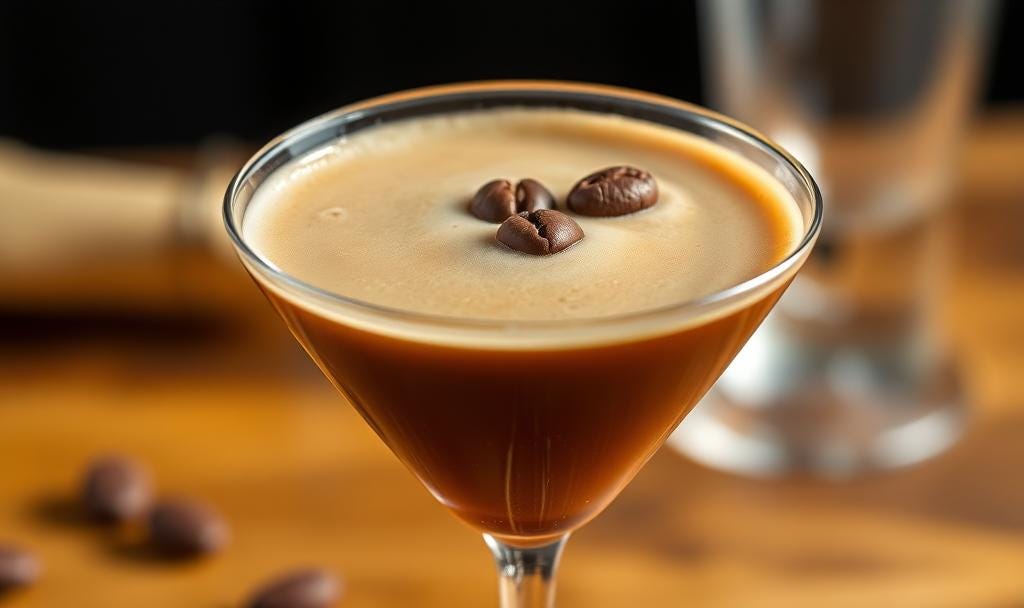
Espresso Martini
Since the weather here in the desert keeps swinging from hot to cool, this cocktail fits perfectly on the menu—it’s rich, chilled, and elevates the cake more than I expected. Plus, we’re using the DIY Kahlua we made back in February.
You’ll find the recipe in Pairings & Pours No. 5: Cocktails & Cake.
Cheers!
Next Week: Great Grandma Clara Baker’s Lemon Glaze Cake paired with sparkling French lemonade (and maybe a splash of vodka too!).
Some links may be affiliates, meaning I earn a small commission at no cost to you.
So so good as a child my favorite and the frosting was so yummy you could eat it without the cake. Needless to say I would end up with cake and frosting on my clothes my face and the kitchen counter but boy it was worth it
Why is it when you are a child everything taste better?